
Rabu, 29 Juli 2015
SQL injection

Rabu, 04 Februari 2015
I Delete a Blog on Blogger
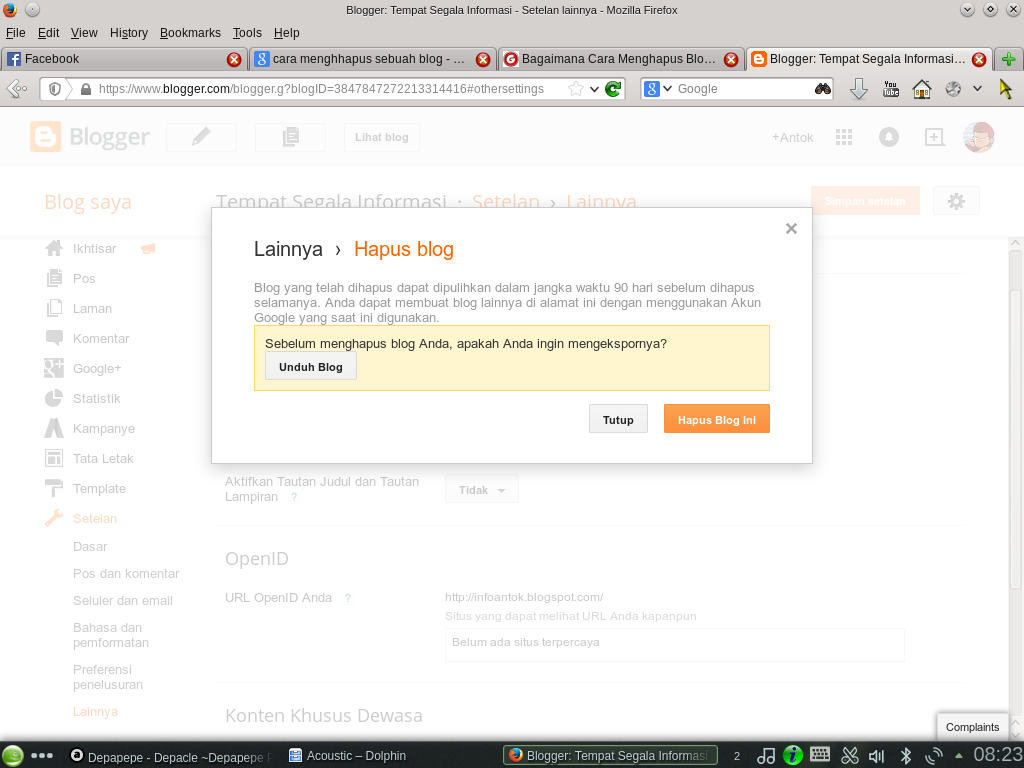
Today many blogs that allow users neglected blog. Various preoccupations of bloggers so just let his blog. Of course this is very detrimental to the new blog users because the number of blog address they like no / reduced.
Here's how to remove an abandoned blog
Good luck ....
1. Sign in go to the dashboard blog.

2. The dashboard and then point to the drop-down menu select Setelan.

3. Then on the left sidebar, click on Lainnya

4. Then click on the Blog Tools and klik on Hapus Blog

note : Before deleting blog, you can download your blog for another time then the exported by clicking the Unduh Blog. To immediately remove the blog, press Hapus Blog Ini..
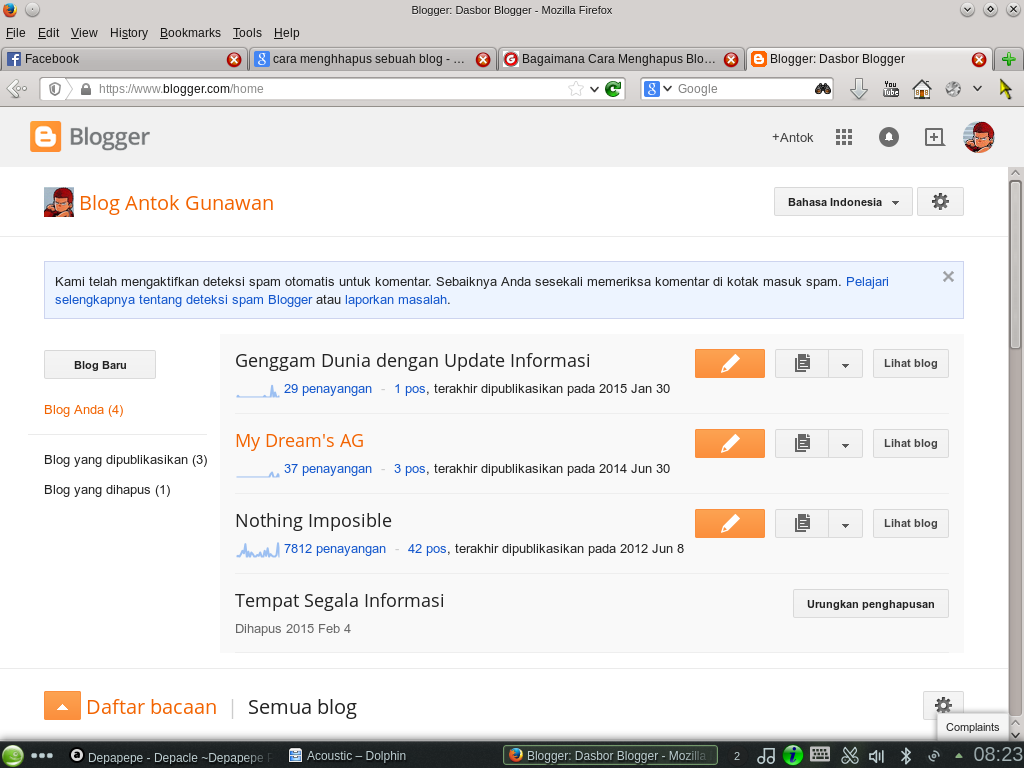
The view that has been deleted
Jumat, 08 Juni 2012
Upload Vulnerability

Upload is process
of transmitting a file from a computer system to other computer
systems. Attacker to upload files to insert in accordance with the
desired command so that it can remotely victim. This attack is
passive as it waits for the victim to take action on a file that is
uploaded.
XSS
 XSS
is a hacking technique that uses a script-injection method with a
certain gap in a web page. The gap can sometimes be through the input
form, or by modifying the URL parameter. The script that is injected,
there are several kinds, can HTML tags, JavaScript, PHP, ASP (as web
server), etc.
XSS
is a hacking technique that uses a script-injection method with a
certain gap in a web page. The gap can sometimes be through the input
form, or by modifying the URL parameter. The script that is injected,
there are several kinds, can HTML tags, JavaScript, PHP, ASP (as web
server), etc.Minggu, 18 Maret 2012
Magic Number
A magic number or sometimes referred to as a file signature is a number embedded at or near the beginning of a file that indicates its file format (i.e., the type of file it is). magic number can be viewed using a hex editor.
for example, the magic number for JPEG (Joint Photographic Experts Group) image files is 0x4A464946, which is the ASCII equivalent of JFIF (JPEG File Interchange Format). However, JPEG magic numbers are not the first bytes in the file; rather, they begin with the seventh byte.
Similarly, the magic number for image files having the subsequently introduced GIF89a format is 0x474946383961. For both types of GIF (Graphic Interchange Format) files, the magic number occupies the first six bytes of the file. They are then followed by additional general information (i.e., metadata) about the file.
for example, the magic number for JPEG (Joint Photographic Experts Group) image files is 0x4A464946, which is the ASCII equivalent of JFIF (JPEG File Interchange Format). However, JPEG magic numbers are not the first bytes in the file; rather, they begin with the seventh byte.
Similarly, the magic number for image files having the subsequently introduced GIF89a format is 0x474946383961. For both types of GIF (Graphic Interchange Format) files, the magic number occupies the first six bytes of the file. They are then followed by additional general information (i.e., metadata) about the file.
Slack Space
Slack space is the area between the end of a file and end of the last cluster or sector used by the file in question. Area is an area that will not be used again to store the information there, so the area is "wasted" useless. Slackspace is common in file systems that use a large cluster size, while the file system that uses a small cluster size can organize the storage media more effectively and efficiently.Amount of wasted disk space can be thought is estimated by multiplying the number offiles (including the number of directories) with half the size of a cluster.
Unallocated Space
Unallocated Space is available disk space that is not allocated to any
volume. The type of volume that you can create on unallocated space
depends on the disk type. On basic disks, you can use unallocated space
to create primary or extended partitions. On dynamic disks, you can use
unallocated space to create dynamic volumes
If the operating system writes a file to a certain space on the hard drive that part of the drive is now “allocated”, as the file is using it the space, and no other files can be written to that section. If that file is deleted then that part of the hard drive is no longer required to be “allocated” it becomes unallocated. This means that new files can now be re-written to that location.
On a standard, working computer, files can only be written to the unallocated space.
If a newly formatted drive is connected to a computer, virtually all of the drive space is unallocated space (a small amount of space will be taken up by files within the file system, e.g $MFT, etc). On a new drive the unallocated space is normally zeros, as files are written to the hard drive the zeros are over written with the file data
If the operating system writes a file to a certain space on the hard drive that part of the drive is now “allocated”, as the file is using it the space, and no other files can be written to that section. If that file is deleted then that part of the hard drive is no longer required to be “allocated” it becomes unallocated. This means that new files can now be re-written to that location.
On a standard, working computer, files can only be written to the unallocated space.
If a newly formatted drive is connected to a computer, virtually all of the drive space is unallocated space (a small amount of space will be taken up by files within the file system, e.g $MFT, etc). On a new drive the unallocated space is normally zeros, as files are written to the hard drive the zeros are over written with the file data
Langganan:
Postingan (Atom)